About this New York practice test
This free NY permit practice test works like the real New York State learner permit test: 20 multiple-choice questions, and you need 14 right to pass. Every question was written from the official New York State Driver's Manual, and each answer comes with a short explanation and the chapter it comes from.
No signup is needed. Take the test below, see which topics you missed, then read the guide underneath to learn how the real DMV test works, what to bring, and the rules that trip up the most first-time test takers.
How the New York permit test works
The New York learner permit test has 20 multiple-choice questions. To pass, you must answer at least 14 correctly. There is a second rule that catches people out: four of the questions are about road signs, and you must get at least two of those four right. If you miss three sign questions, you fail even if the rest of your answers are perfect.
You can take the test at a DMV office (offered in 20 languages), or online if you are under 18. The questions are drawn from chapters 4 through 11 of the Driver's Manual: traffic control, intersections and turns, passing, parking, defensive driving, alcohol and drugs, special driving conditions, and sharing the road.
The DMV does not publish a time limit for the office test, so don't count on one. Work steadily, read every option, and treat each question on its own.
Who can get a New York learner permit
New York residents can apply for a learner permit at age 16. If you are under 18, a parent or guardian must sign your consent form (MV-45).
New York's permit for drivers under 18 is called a junior learner permit, and it comes with extra rules. Those rules depend on where you drive. New York City, Long Island and upstate each have their own hours and supervisor requirements, listed below.
What to bring to the DMV
New York uses a points system to prove who you are. Your documents must add up to at least 6 points, and the DMV form ID-44 lists how many points each document is worth. Bring originals or certified copies, not photocopies.
- Application for Permit, Driver License or Non-Driver ID Card (MV-44)
- Proofs of identity worth at least 6 points (form ID-44)
- Proof of date of birth and proof of your Social Security number
- Proof of New York State residency
- Parent or guardian consent (MV-45) if you are under 18
How much the permit costs
In New York, one fee covers both the learner permit and your first license. The amount depends on your age and on whether you live in the Metropolitan Commuter Transportation District (the five boroughs plus Dutchess, Nassau, Orange, Putnam, Rockland, Suffolk and Westchester). Form ID-44 states the learner permit fee is no more than $136. Check the DMV fees page for your exact amount before you go.
Junior learner permit rules
Once you have your permit, you can only drive with a supervising driver who is 21 or older and licensed to drive the vehicle. Here are the main restrictions from the DMV:
- Only your supervising driver may sit in the front seat.
- New York City: no driving between 9 PM and 5 AM. During the day, your supervisor must be a parent, guardian, driver-ed teacher or driving-school instructor.
- Nassau and Suffolk counties: no driving between 9 PM and 5 AM.
- Upstate: from 9 PM to 5 AM you may drive only with a parent, guardian, driver-ed teacher or driving-school instructor.
- Before your road test: hold your permit for at least 6 months, log 50 hours of practice with 15 after sunset, and complete the 5-hour pre-licensing course (or driver education).
How to study for the NY permit test
Read the New York State Driver's Manual (MV-21) once from start to finish, then use practice tests to find your gaps. A practice test is only useful if you review your mistakes: after each attempt, reread the manual section for every question you missed.
Spend extra time on the road signs. The sign rule means a weak spot there can fail you on its own. Learn sign colors and shapes, not just the words: the manual explains that warning signs are yellow diamonds and that STOP signs are red with white letters, and many questions show you only the sign.
Top topics on the New York test
Road signs
Four questions on the real test are road signs, and you need at least two right. Expect regulatory signs, warning signs and pavement markings.
Alcohol & drugs
New York has several alcohol levels: .08 for DWI, .18 for Aggravated DWI, and more than .05 as evidence of impairment. Drivers under 21 are covered by the Zero Tolerance law.
Right of way
Who goes first at intersections, at traffic circles, when turning left, and for pedestrians and emergency vehicles.
Parking
Exact distances: 15 ft from a fire hydrant, 20 ft from a crosswalk at an intersection, 30 ft from a traffic light or STOP sign, 50 ft from a railroad crossing.
Safe driving
The two-second rule, when headlights are required, when to dim your high beams, and driving at night and in bad weather.
Sharing the road
School buses with flashing red lights, the Move Over law, bicycles, motorcycles, trucks and pedestrians.
Common mistakes
Ignoring the road-sign rule
Scoring 15 out of 20 is not a pass if three of the misses were road signs. Practice signs until you get them right every time.
Mixing up the alcohol numbers
Learn which number goes with which offense: .08 for DWI, .18 for Aggravated DWI, more than .05 as evidence of impairment, and .02 to .07 for drivers under 21.
Guessing parking distances
The hydrant (15 ft), crosswalk (20 ft), STOP sign or traffic light (30 ft) and railroad (50 ft) distances are all different. Write them down and quiz yourself.
Passing a stopped school bus on a divided road
In New York you must stop for a school bus with flashing red lights even on a divided highway, at least 20 feet away.
Forgetting when headlights are required
Headlights must be on from half an hour after sunset to half an hour before sunrise, when you can't see 1,000 feet ahead, and whenever weather requires your wipers.
All 20 free test questions and answers
Want to study without the quiz? Here is every question from the free practice test above, with the correct answer and explanation.
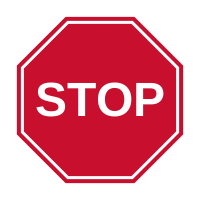
You reach this sign, and there is no stop line and no crosswalk. Where should you stop?
- A. Before entering the intersection, where you can see cross traffic (correct)
- B. In the middle of the intersection
- C. Exactly beside the sign post, wherever it stands
- D. You do not need to stop if there are no lines
With no stop line or crosswalk, stop before entering the intersection at the point where you can see cross traffic (NY Driver's Manual, Ch. 4: Traffic Signs).
What does this sign tell you?
- A. Right lane ends ahead
- B. Turn right at the next street
- C. Divided highway ends
- D. Keep to the right of the divider (correct)
This sign means keep right of the divider (NY Driver's Manual, Road Signs You Must Know).
You are on a one-way road and see this sign. What does it mean?
- A. Traffic ahead moves in both directions (correct)
- B. The road ahead is one-way
- C. Pass on either side
- D. Divided highway begins
This sign warns of two-way traffic (NY Driver's Manual, Road Signs You Must Know).
Warning signs are usually which shape and color?
- A. White rectangle with black letters
- B. Orange circle with white letters
- C. Blue square with white letters
- D. Yellow diamond with black letters or symbols (correct)
Warning signs are yellow and diamond-shaped with black letters or symbols (NY Driver's Manual, Ch. 4: Traffic Signs).
Two cars reach an intersection with no signs or signals at the same time. Who must yield?
- A. The driver on the right yields to the driver on the left
- B. The driver on the left yields to the driver on the right (correct)
- C. The larger vehicle goes first
- D. Whoever honks first goes first
At an uncontrolled intersection, the driver on the left must yield to the driver on the right (NY Driver's Manual, Ch. 5: Right-of-Way).
A pedestrian is crossing at a corner with no painted crosswalk. What must you do?
- A. Go first because there are no lines
- B. Yield to the pedestrian (correct)
- C. Honk to warn them
- D. Yield only if a sign says so
You must yield to pedestrians in marked or unmarked crosswalks (NY Driver's Manual, Ch. 5: Right-of-Way).
A school bus ahead of you on a two-way road stops and flashes its red lights. Who must stop?
- A. Only traffic behind the bus
- B. Traffic from both directions (correct)
- C. Only traffic coming toward the bus
- D. Only vehicles near a school
When a stopped school bus flashes red lights, traffic from either direction must stop before reaching it (NY Driver's Manual, Ch. 6: School Buses).
If no speed limit is posted in New York State, what is the most you may drive?
- A. 55 mph (correct)
- B. 45 mph
- C. 65 mph
- D. 70 mph
If no limit is posted, drive no more than 55 mph (NY Driver's Manual, Ch. 8: Speed Limits).
How close to a fire hydrant may you park?
- A. No closer than 5 feet
- B. No closer than 15 feet (correct)
- C. No closer than 10 feet
- D. No closer than 30 feet
You may not park, stop or stand within 15 feet of a fire hydrant (NY Driver's Manual, Ch. 7: Parking Regulations).
You hear a loud thump and a front tire blows out. What should you do first?
- A. Brake hard right away
- B. Steer quickly onto the shoulder
- C. Hold the wheel firmly and ease off the gas (correct)
- D. Shift into reverse
In a blowout, hold the steering wheel firmly and ease off the gas; do not brake until the vehicle is under control (NY Driver's Manual, Ch. 10: Driving Emergencies).
In New York, a blood alcohol content (BAC) at what level is evidence of intoxication (DWI)?
- A. .02 percent or higher
- B. .05 percent or higher
- C. .12 percent or higher
- D. .08 percent or higher (correct)
A BAC of .08 percent or higher is evidence of intoxication. (NY Driver's Manual, Ch. 9: Alcohol and Other Drugs).
You took a cold remedy and then had one drink. How might this affect your driving?
- A. The medicine cancels out the alcohol
- B. One drink has no effect with medicine
- C. It makes you more alert behind the wheel
- D. It could affect you as much as several drinks (correct)
Never mix alcohol with other drugs; one drink taken with a cold remedy can affect you as much as several drinks. (NY Driver's Manual, Ch. 9: Alcohol and Other Drugs).
What does the two-second rule help you judge?
- A. Your following distance behind the car ahead (correct)
- B. How long to stop at a STOP sign
- C. How early to signal a turn
- D. How long a yellow light lasts
Use the two-second rule to check that you are not following the vehicle ahead too closely. (NY Driver's Manual, Ch. 8: Defensive Driving).
At night, you must switch to low beams when an oncoming vehicle is within how many feet?
- A. 100 feet
- B. 200 feet
- C. 500 feet (correct)
- D. 1,000 feet
Use low beams within 500 feet of an oncoming vehicle. (NY Driver's Manual, Ch. 10: Special Driving Conditions).
When may metal-stud (studded) tires be used in New York State?
- A. November 1 through March 31
- B. October 1 through May 15
- C. December 1 through March 1
- D. October 16 through April 30 (correct)
Metal-stud tires may be used in New York only from October 16 through April 30. (NY Driver's Manual, Ch. 10: Special Driving Conditions).
How must a 3-year-old ride in a car in New York?
- A. In a federally approved child safety seat (correct)
- B. In a regular seat belt
- C. On an adult's lap
- D. In a booster seat with a lap belt only
Children under age 4 must ride in a federally approved child safety seat attached by a seat belt or LATCH system. (NY Driver's Manual, Ch. 8: Defensive Driving).
What is the minimum age to get a learner permit in New York?
- A. 15
- B. 17
- C. 16 (correct)
- D. 18
You must be at least 16 to apply for a learner permit in New York. (NY Driver's Manual, Ch. 1: Driver Licenses).
How long must you hold a junior learner permit before you can schedule a road test?
- A. At least 30 days
- B. At least three months
- C. At least six months (correct)
- D. At least one year
A junior permit must be held for at least six months (not counting suspension time) before a road test can be scheduled. (NY Driver's Manual, Ch. 2: How to Keep Your License).
A stopped school bus is flashing its red lights. Which drivers must stop?
- A. Only traffic behind the bus
- B. Only traffic facing the bus
- C. Only drivers in the right lane
- D. Traffic from both directions (correct)
When a stopped school bus flashes its red lights, traffic from either direction must stop before reaching the bus. (NY Driver's Manual, Ch. 6: Passing).
On a two-lane country road, a tow truck with amber hazard lights is stopped on the shoulder. What does the Move Over Law require?
- A. Reduce your speed (correct)
- B. Nothing, since it is not a police car
- C. Come to a full stop
- D. Sound your horn as you pass
Under the Move Over Law, drivers must reduce speed on all roads for stopped emergency or hazard vehicles with their lights on. (NY Driver's Manual, Ch. 5: Intersections and Turns).
New York permit test FAQ
How many questions are on the NY permit test?
The New York learner permit test has 20 multiple-choice questions. You need at least 14 correct, and you must answer at least 2 of the 4 road-sign questions correctly.
Can I take the NY permit test online?
Yes, if you are under 18 the DMV lets you take the permit test online. Otherwise you take it at a DMV office, where it is offered in 20 languages.
How old do you have to be to get a learner permit in New York?
You can apply at 16. If you are under 18, a parent or guardian must sign your consent.
What should I bring to get my NY learner permit?
Bring a completed MV-44 application, identity documents worth at least 6 points (see form ID-44), proof of date of birth, proof of your Social Security number, and proof of New York residency. Applicants under 18 also need parent or guardian consent.
How much does a learner permit cost in New York?
One fee covers both the permit and your first license. It depends on your age and county. Form ID-44 says it is no more than $136. Check the DMV fees page for your exact amount.
When can I take my road test?
You must hold your permit for at least 6 months, complete 50 hours of supervised practice (15 after sunset), and finish the 5-hour pre-licensing course or driver education.
Is this practice test the same as the real DMV test?
No. These are original questions written from the official NY Driver's Manual, in the same format and with the same pass mark as the real test. The DMV does not publish its actual test questions.
Official sources
- New York State Driver's Manual (MV-21)
- Driver's Manual & practice tests (HTML)
- Get a learner permit
- Prepare for and take your permit test
- Learner permit restrictions
- Graduated license law
- Proofs of identity (ID-44)
- Fees and refunds
- Pre-licensing course
- Road signs you must know
Rules change. Always confirm details with the New York State Department of Motor Vehicles before your test.